I don't have a 4g63 engine for a reference so I'm a little confused on the turbo oiling options/procedure when setting up a 4g64.
What I think a lot of people (especially myself) would like to see would be pics showing:
1. where the standard turbo oil port on a DOHC head is
2. how to block it off if needed
3. options on how to connect a turbo oil feed line on a DOHC 4g64 with the standard Forward Facing Oil Filter Housing (FF-OFH)
I'm sure another write-up covering the 4g63 would be good such as:
1. how the normal 4g63 tubo is oiled (connections and oil line)
2. what needs to be changed to rotate the tubo on a 4g63
Thankx, David.
Can someone post a write up on 4g64 tubo oiling options?
Moderators: DJpowerHaus, mattmartindrift
-
DJpowerHaus
- Sir Post A Lot
- Posts: 1779
- Joined: Wed Apr 07, 2004 3:24 pm
- Location: Baltimore, MD
- Contact:
Re: Can someone post a write up on 4g64 tubo oiling options?
All of this stuff can be learned simply by looking at the motor and following the oil pathways in the pump, block and head. The FSM also has a diagram of the oiling system to help too.AustinTSI wrote:I don't have a 4g63 engine for a reference so I'm a little confused on the turbo oiling options/procedure when setting up a 4g64.
What I think a lot of people (especially myself) would like to see would be pics showing:
1. where the standard turbo oil port on a DOHC head is
2. how to block it off if needed
3. options on how to connect a turbo oil feed line on a DOHC 4g64 with the standard Forward Facing Oil Filter Housing (FF-OFH)
I'm sure another write-up covering the 4g63 would be good such as:
1. how the normal 4g63 tubo is oiled (connections and oil line)
2. what needs to be changed to rotate the tubo on a 4g63
Thankx, David.
The OEM turbo oil feed is located on the back of the head on the exhaust side. To block it off, simply put some pipe dope on a clean bolt and install it in the hole. Be sure it the correct thread and not so long that it blocks off the entire pathway. Its also an option to use a crush washer on a bolt to seal this rather than pipe dope.
Define forward facing? Forward is different for us than for DSM guys. The oil filter housing is again something you can trace out by looking at the part and visualizing how the oil gets from one end to the other.

Getting the engine bolted in is about 10% of the way there.
The next 80% can go quickly with help and skill.
That last 10% takes about as long as the 90% that came before it.
-
DJpowerHaus
- Sir Post A Lot
- Posts: 1779
- Joined: Wed Apr 07, 2004 3:24 pm
- Location: Baltimore, MD
- Contact:
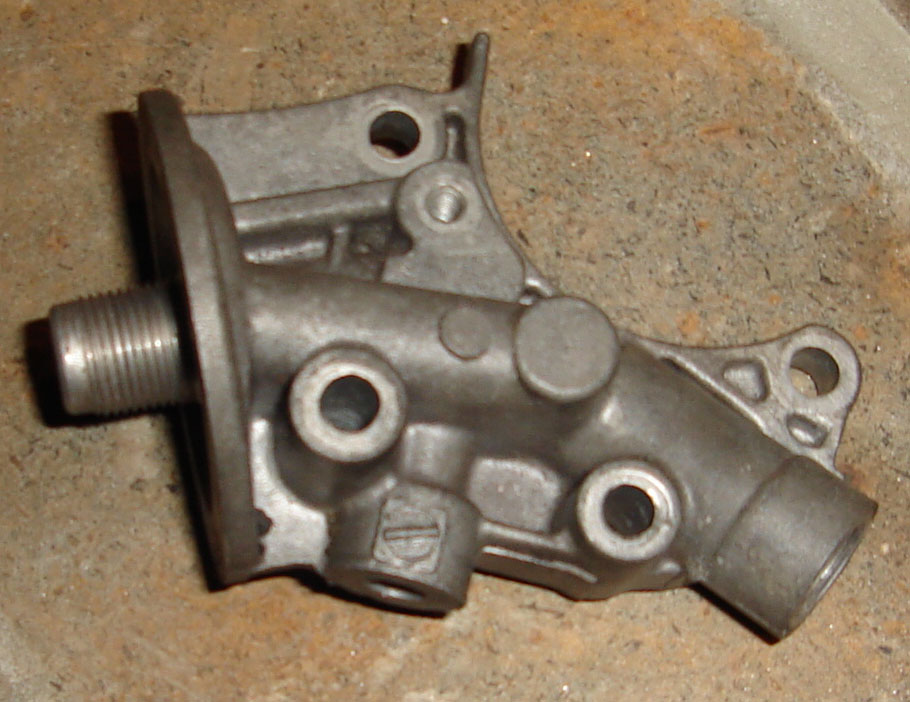
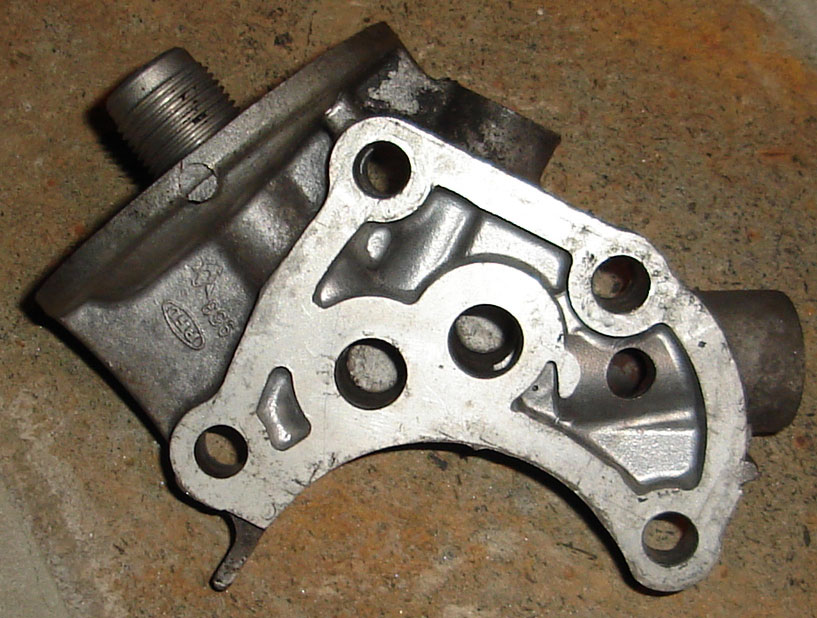
This is the oil filer housing that came on the RWD trucks and vans:
On the pics below you have the oil filter (duh), the threaded port of the oil pressure sender and the port for the oil pressure regulator (spring, piston, crush washer and retaining bolt). There isnt really a spot to add a oil feed unless you drill and tap into it somewhere.
RWD turbo applications with an oil cooler (4G63 Starions) had a similar oil filter housing, but with a few extra spots for a turbo oil feed and oil cooler in/out:
On the pics below you have the oil filter (duh), the oil cooler thermostat below that, turbo oil feed on the back, oil cooler in / out on front, pressure regulator on the right, pressure sender on the bottom and 3 or so blocked or untapped machining ports that could be used for sensors and such.


On the pics below you have the oil filter (duh), the threaded port of the oil pressure sender and the port for the oil pressure regulator (spring, piston, crush washer and retaining bolt). There isnt really a spot to add a oil feed unless you drill and tap into it somewhere.
RWD turbo applications with an oil cooler (4G63 Starions) had a similar oil filter housing, but with a few extra spots for a turbo oil feed and oil cooler in/out:
On the pics below you have the oil filter (duh), the oil cooler thermostat below that, turbo oil feed on the back, oil cooler in / out on front, pressure regulator on the right, pressure sender on the bottom and 3 or so blocked or untapped machining ports that could be used for sensors and such.
Getting the engine bolted in is about 10% of the way there.
The next 80% can go quickly with help and skill.
That last 10% takes about as long as the 90% that came before it.