[/size
If you are going to use a front upper coolant outlet, the hole size will be restricted because you are inserting the new outlet neck INSIDE of the existing outlet...........sooooooooooo if you are loosing area in the front....creating a resrtiction or delay...........why not pick up the extra needed outlet from the rear of the head.....that way you would have 80% flow from the front ( after cylinder head / coolant flow mods) and pick up 20% flow from the rear outlet location......bring them both together at a surge tank ( air seperation canister) located in the front of the engine and route a single outlet from the surge tank to the upper radiater inlet...then you would have complete control over flow.
Put an 'AN" fitting on the back of the head, have a premade hose made with 'AN' fittings about 1/2" inside diameter...maybe even put a restricter valve in the hose so you can test and change the flow from the rear exit.
Mount a surge tank in the upper left front of the engine and connect the two hoses.......relocate your thermostate to the input side of the water pump and relocate your thermo sensers there
Clean, simple, cheap and flow like the misssippi river
No sleep last night Smog
bill
why not two exit lines for coolant?
Moderators: DJpowerHaus, mattmartindrift
-
Bill Hincher
- Donating Member
- Posts: 1625
- Joined: Thu Jun 22, 2006 8:57 pm
- Location: Toledo,Ohio
- Contact:
-
DJpowerHaus
- Sir Post A Lot
- Posts: 1779
- Joined: Wed Apr 07, 2004 3:24 pm
- Location: Baltimore, MD
- Contact:
-
jeffball610
- Too Much Time on His Hands
- Posts: 619
- Joined: Wed Feb 22, 2006 5:29 am
- Location: Las Vegas, NV
I'm not sure why you'd want 2 outlets. If you're going to put an AN line from the rear of the head, why not just run all of your coolant from there? I think you could make some extra room if you can find a tight radius bent pipe and weld it to a flange to fit the stock outlet. Or even just put an AN fitting on a flange. You could mount the thermostat somewhere more practical. We'll see what I come up with when I get my motor mocked up. (hopefully soon)
-
Bill Hincher
- Donating Member
- Posts: 1625
- Joined: Thu Jun 22, 2006 8:57 pm
- Location: Toledo,Ohio
- Contact:
You are all quite correct.........but you are restricting yourself into a traditional train of thought.....we gotta think outta the box.......yes, there is no difference in the restriction of the thermostat and / or the restriction in the cylinder head outlet........but I am trying to say is ..........that restriction by itself is the problem........its in the wrong place and changes the TIMING of the cooling...........the thermostat BEFORE the radiater holds coolant in the block/cylinder head longer.........yeah that collects heat longer ...but in this case it holds the coolant there TOO LONG and turns the coolant into steam.......

 This is a Honda style
Okay, new technology says to place the thermostat/restriction at the inlet side of the water pump to hold the coolant in the radiater longer
remote thermostats are a dime a dozen on used engines........they can be used to mount the termostat AFTER the radiater and the coolant stays in the radiater longer for better cooling.
Whats the advantage to all this you ask? well....the size of the radiater.......if you can reduce the square area required to transfer the heat to the air, you reduce the frontal area of the car and the airodynamics are improved.......When Thermostates were conveinently mounted on the input side of the radiater on the prehistoric v-8 the front of the car looked like a truck with a 20 gal coolant system and a 4' x 4' radiater behind a grille from a school bus.......your dealing with a system that holds 1 gallon coolant...small frontal areas and much smaller radiaters
In the event , that you still want to used the thermostat in the same front position, it's not too much of a strech to add a second line at the back of the head ( not too big but adequate enough to transfer SOME coolant) to the front of the head ( under the intake plentium) and route the coolant into the thermostat body under the thermostate........that way the thermostat will regulate the flow no matter where it comes from.
Later
Last edited by Bill Hincher on Fri Mar 07, 2008 8:38 pm, edited 1 time in total.
Bill,
I have never been comfortable with the front of the head thermostat housing location. I just do not see how the rear of the engine is going to get enough cooling. So I suggested that someone could tap their heater core circuit in the original thermostat housing location (in the rear of the head).
This way, certain percentage of the coolant will flow through the head and cool off the in the heater core, before it goes back into the engine.
Has anyone try this yet?
I have never been comfortable with the front of the head thermostat housing location. I just do not see how the rear of the engine is going to get enough cooling. So I suggested that someone could tap their heater core circuit in the original thermostat housing location (in the rear of the head).
This way, certain percentage of the coolant will flow through the head and cool off the in the heater core, before it goes back into the engine.
Has anyone try this yet?
Leon Reitman
'96 Spyder GST
'93 Summit Wagon AWD (4G63 swap)
'80 Triumph TR7 Spyder GST (4G63 swap)
'96 Spyder GST
'93 Summit Wagon AWD (4G63 swap)
'80 Triumph TR7 Spyder GST (4G63 swap)
-
jeffball610
- Too Much Time on His Hands
- Posts: 619
- Joined: Wed Feb 22, 2006 5:29 am
- Location: Las Vegas, NV
Why not add two AN fittings? One at the rear and one on the front. Another part that Jay Racing offers is an AN fitting to go in the front freeze plug. Then add the thermostat housing to the waterpump inlet. That solves all that without getting too complex or fabricating your own parts. All you need now is a radiator with a -12AN inlet and figure out what thermostat housing you want to use. The DSM piece has too many fittings to look clean on the front of the engine. I'd imagine any housing will do as long as you can fit it to the stock water pump.

Thermostat has to be before the radiator (or it might never open), so you shouldn't put it just before the pump. However the idea of AN line to a thermostat housing and then to the radiator, should work.Then add the thermostat housing to the waterpump inlet.
Leon Reitman
'96 Spyder GST
'93 Summit Wagon AWD (4G63 swap)
'80 Triumph TR7 Spyder GST (4G63 swap)
'96 Spyder GST
'93 Summit Wagon AWD (4G63 swap)
'80 Triumph TR7 Spyder GST (4G63 swap)
-
Bill Hincher
- Donating Member
- Posts: 1625
- Joined: Thu Jun 22, 2006 8:57 pm
- Location: Toledo,Ohio
- Contact:
the thermostate mounted on the upper part of the block has the coolant pushed against it........and it has to force its way open when heated.......the thermostat mounted in front of the water pump pulls coolant acrossed it..........that is why it has to be a 'compound' style thermostat.......thats why it works with the tempurature.....coolant is curculated through it not just behind it...........I assure you...........if Toyota and Honda use this style of cooling system....it WORKS!
I guess I am not familiar with “compound thermostats”.
Out of curiosity, why..... are you...... talking ........ like this.......
It makes your otherwise good and informative posts very difficult to read and understand!
Out of curiosity, why..... are you...... talking ........ like this.......
It makes your otherwise good and informative posts very difficult to read and understand!
Leon Reitman
'96 Spyder GST
'93 Summit Wagon AWD (4G63 swap)
'80 Triumph TR7 Spyder GST (4G63 swap)
'96 Spyder GST
'93 Summit Wagon AWD (4G63 swap)
'80 Triumph TR7 Spyder GST (4G63 swap)
-
Bill Hincher
- Donating Member
- Posts: 1625
- Joined: Thu Jun 22, 2006 8:57 pm
- Location: Toledo,Ohio
- Contact:
GR,
I have learned to make sure my complete thought is understood by breaking up my sentences, because up until now, most of my conversations have been with friends in other countries that cant speak english...................also...............I been trying to explain something.........that seems hard to grasp......................much like talking to my wife...............sooooooooooooooo i talk slooooooooooooooooooooower.........and slowwwwwwwwwwwwwwwer.......focused in her eyes.................making sure she looks right at me..............and all of a sudden.........she says OHHHHHHH
 HHHHHHHHH!.............just like the kid in the back of third hour history did.......at the end of the first semester!
careful, this could easily be misinterpreted to be offensiveBill Hincher wrote:
GR,
I have learned to make sure my complete thought is understood by breaking up my sentences, because up until now, most of my conversations have been with friends in other countries that cant speak english...................also...............I been trying to explain something.........that seems hard to grasp......................much like talking to my wife...............sooooooooooooooo i talk slooooooooooooooooooooower.........and slowwwwwwwwwwwwwwwer.......focused in her eyes.................making sure she looks right at me..............and all of a sudden.........she says OHHHHHHH

-
DJpowerHaus
- Sir Post A Lot
- Posts: 1779
- Joined: Wed Apr 07, 2004 3:24 pm
- Location: Baltimore, MD
- Contact:
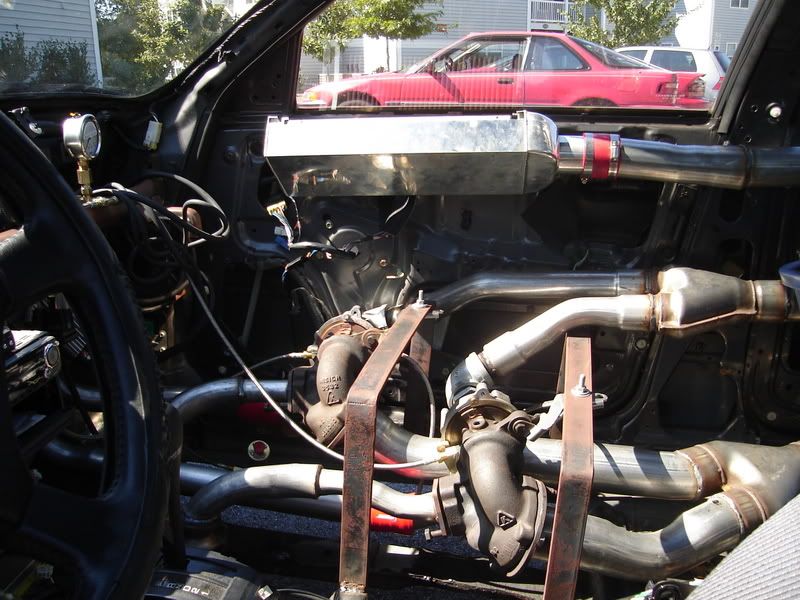
This is probably what Bill's turbo setup looks like:
Gotta think outta the box.
That AN fitting is sort of scary... they want you to use a -12 fitting on your cooling system? I've never seen a 3/4" waterhose on a car. Maybe -20 or -32, but not -12.
Gotta think outta the box.
That AN fitting is sort of scary... they want you to use a -12 fitting on your cooling system? I've never seen a 3/4" waterhose on a car. Maybe -20 or -32, but not -12.

Getting the engine bolted in is about 10% of the way there.
The next 80% can go quickly with help and skill.
That last 10% takes about as long as the 90% that came before it.

-
Bill Hincher
- Donating Member
- Posts: 1625
- Joined: Thu Jun 22, 2006 8:57 pm
- Location: Toledo,Ohio
- Contact:
 300zx turbo in the back seat of an 87 civic
 took the ft end out of a maxima and stuffed it into the back seat
 its a very nice and clean project
-
Bill Hincher
- Donating Member
- Posts: 1625
- Joined: Thu Jun 22, 2006 8:57 pm
- Location: Toledo,Ohio
- Contact:
 when its cold a bypass is open
 when its hot the bypass is closed......
-
Bill Hincher
- Donating Member
- Posts: 1625
- Joined: Thu Jun 22, 2006 8:57 pm
- Location: Toledo,Ohio
- Contact:
-
Robert Venable
- Donating Member
- Posts: 229
- Joined: Fri Sep 22, 2006 8:37 pm
- Location: BATON ROUGE, LA
I understand you not aggreeing with this mod., what I don't understand is the fact that you always seem to butt in and force your negative oppinion on everyone else. Why is it that?peregrine wrote:all these discussions on the thermo housing make my head swim. pound the fucking firewall in and do it the right way mitsu intended.

Why not just let Bill Hincher say what he has to say and let those who want to learn about it learn?:?: If you don't want to see it, just don't read the post. It would be that much less of an effort on your part.
All he is comming up with is theories, and he actually has reasonable ones with some kind of facts to back it up. All that I can see comming from you is "it was engineered this way and there just isn't any better way."
Well, if this is the right way because Mitsu intended it, why didn't they put this motor in your car to begin with? It would seem, to me, that if Bill is wrong for changing this part, that you are just as wrong for what you did with your motor/head.
I'm sorry if you take this personal(I have much respect for your car and how you did it and I'm not trying to insult you), I just think that you should respect Bill Hincher's oppinion as HIS oppinion and let him voice it for those who wish to hear/read it. If it really pains you to see this then don't look. Now if you have some actuall data and proof that Bill is wrong, please I would LOVE to read about it, but I just don't see any reason for this kind of post being directed at a person that is trying to come up with new inovative ways to solve problems others have.
Again, I appologize for any disruption this may cause.
1990 MIGHTY MAX, REG CAB,
-
Bill Hincher
- Donating Member
- Posts: 1625
- Joined: Thu Jun 22, 2006 8:57 pm
- Location: Toledo,Ohio
- Contact:
Well back to cooling
Head gasket failure is deeply influenced by the fact you have a cast iron block and an aluminum cylinder head, one of the major contributers to head gasket failure is 'thermo shock' which is produced when the thermostate opens after reaching its designed operating tempurature.
The coolant is boiling hot in the engine, the thermostat opens and from the rush of (cold)coolant into the engine block from the radiater ' thermo shock' takes place in the block and cylinder head.
Its no different then throwing cold water on a hot exhaust manifold.
The engineers came up with a way to circulate coolant BEFORE the thermostat opened by using a bypass to ciculate coolant . But the bypass was a 'static' design without controls. to make a true operating system, the engineers went on to build a ' dynamic' system.
 This is a compound thermostat in the closed position, notice the back side is open to the two small ports, this would be an excellent position to use Leon's idea of using the heater core as a cooler, becuase the engine is ' preheating' before the main thermostat opens.
 now you see the thermostat in the open positoin, the one we are all used to seeing, but notice that the rear bypassed is now closed. Now you can see the coolant comes from the radiater and routes to the water pump.
But lets put this together, this is a ' balanced' system that is ' dynamic' not ' static' . lets say you are driving on a hot day and the thermostat is wide open, you drive into a thunder storm, the radiater cools below the thermostat's designed opening temp and it closes, now the 'bypass side' is back in operation until the temp comes back up to open the thermostat.
The other nice thing about this system is ' cavitation'
Cavitation takes place for a couple of reason's the impeller to the water pump has fins that are traveling faster near the drive shaft then the fins at the outside of the drive shaft. When you make the water pump out accelerate ( over run) the coolant flow ( by lets say dead stop drag racing)
it creates air bubbles in the vacuum at the center of the water pump, thats why the water pump is fed at the center of the pump, to be able to feed the coolant to the pump as quickly as possible and aviod cavitaion.
So this 'dynamic' style thermostat bypass is and extra feed to the rear of the water pump, making cavitaion harder. The thermostat is made to be interacitive with the engines cooling needs, almost a 'smart' thermostat system as opposed to a simple one way gate to restrict coolant
Thanks for your time, I know I bug you guys, but I just want you to enjoy all the hard work you do, its no fun to build a car and constantly breakdown, been there, done that, got the t-shirt. I would like you all to succeed at what you want to do ( wish I was a kid again >;o) )
Later
Bill
-
Robert Venable
- Donating Member
- Posts: 229
- Joined: Fri Sep 22, 2006 8:37 pm
- Location: BATON ROUGE, LA
Are you sure cavitation is the correct word for this? I've only ever heard of cavitation happening to the cylinder liners of diesel engines. Would this be the same cavitation??
BTW: Speaking of smart thermostates. I work on BMWs and when you mentioned that I thought I would let you know that most of the new cars have an electrically heated thermostate. IF the DME (German for ECM) sees you driving the car hard before the car is warmed up it will electrically heat the thermostate to open it to prevent thermoshock and to prevent the thermostate from opening too late and possibly damaging the heads (since the heat in the heads would be considerably hotter in the heads of an engine that is driven hard during cold starts.
What kind of other thermostates are avalible from other manufactures???
BTW: Speaking of smart thermostates. I work on BMWs and when you mentioned that I thought I would let you know that most of the new cars have an electrically heated thermostate. IF the DME (German for ECM) sees you driving the car hard before the car is warmed up it will electrically heat the thermostate to open it to prevent thermoshock and to prevent the thermostate from opening too late and possibly damaging the heads (since the heat in the heads would be considerably hotter in the heads of an engine that is driven hard during cold starts.
What kind of other thermostates are avalible from other manufactures???
1990 MIGHTY MAX, REG CAB,
-
Bill Hincher
- Donating Member
- Posts: 1625
- Joined: Thu Jun 22, 2006 8:57 pm
- Location: Toledo,Ohio
- Contact:
WOW! computer controled themostat??????? makes sense though. A lot of times guys try to find a problem in the computer controls and find out the engine has a bad/weak thermostat and the senders are sending false messages.
I am not familiar with this at all, I only do Japanese, But I do have to brush up on VW, I will be an expert witness in a law suit coming up on the Passet Turbo oil contamination case. they have two sides on thier oil indicaters and I have to have a good understanding of that ,because I will be going up against the VW company attorneys
Cavitaion would be the word used any time the coolant looses its ability to conduct the heat away from the heated area. The original surge tanks were created to feed into the back of the water pumps on the old V-8's because they had feeds on both sides of the water pump, not the center. under a load like a NASCAR race they would develope cavitaion becuase the input feed into the water pump would be EXCEEDED by the out put of the pump and develop bubbles between the impeller and the water pump housing
Are their any plans for BMW to use computer controled valve lifetrs yet?
THATS gonna create a whole new animal!
Bill
-
Bill Hincher
- Donating Member
- Posts: 1625
- Joined: Thu Jun 22, 2006 8:57 pm
- Location: Toledo,Ohio
- Contact:
This is a proposal and Just a proposal, I would like so much if all you guys would look at it and give input
 this is how I propose to create a useable cross flow system ( pardon the poor drawing skills)
 I would recommend using a rear outlet to the bypass of the thermostat
after the thermostat opens, the cross flow would be created forward and the coolant would be directed from the radiater to the water pump.
Naturally a surge tank could be mounted in and bleeder vents and safety pressure valve ( radiater cap) but this is just a basic outline of a good system that would be a starting point
Bill
-
Robert Venable
- Donating Member
- Posts: 229
- Joined: Fri Sep 22, 2006 8:37 pm
- Location: BATON ROUGE, LA
How are you controlling the water out of the front of the motor?? Wouldn't this cause a long warm up time with the hot water wanting to leave out of the front outlet? If so, what water is replacing it??
BMW has not told us about any electronic lifters, but I have heard from freinds that International has a running Class 8 truck with this technology that is being tested. Only problems they were having last time I heard was that the solenoids were so fast that they were breaking off the heads of the valves due to the speed/shock of the solenoids. I guess they are trying to work on a way to slow the valve down before it comes to a sudden stop (at peak lift).
What BMW does have currectly is "Valvetronic." This is a system that uses a 3rd shaft (DOHC) that is an ecentric to varry valve lift (from less than 1mm to 9mm at peak) to allow different engine speeds, aka no more throttle body. There is still a throttle body bolted on the motor for back up, and to create 50mb of vaccum in the intake so some emission devices work correctly.
We also have Vanos which is just continously varrible valve timming. The new 500 hp 5.0 V-10 has some kind of "Ionic" spark plug/coil system that doubles as knock sensors(No valvetronic on this motor, just 10 throttle bodies).
The new Direct injection 335 has Twin Coolant (with electric water pump and remote mounted themostate) and oil cooled(oil pump is varible displacement) turbos with waste gates and has about 200 bar(almost 3,000) of fuel pres when operating normally, but if the High pres. pump breaks it can operate on 5 bar of fuel pres-- just not in direct injection mode.
Lets not even get into Magnesseum blocks, Night vision, Steering that turns the wheels for you, heads up display, Active roll bars, and keyless starting/access systems.
BMW has not told us about any electronic lifters, but I have heard from freinds that International has a running Class 8 truck with this technology that is being tested. Only problems they were having last time I heard was that the solenoids were so fast that they were breaking off the heads of the valves due to the speed/shock of the solenoids. I guess they are trying to work on a way to slow the valve down before it comes to a sudden stop (at peak lift).
What BMW does have currectly is "Valvetronic." This is a system that uses a 3rd shaft (DOHC) that is an ecentric to varry valve lift (from less than 1mm to 9mm at peak) to allow different engine speeds, aka no more throttle body. There is still a throttle body bolted on the motor for back up, and to create 50mb of vaccum in the intake so some emission devices work correctly.
We also have Vanos which is just continously varrible valve timming. The new 500 hp 5.0 V-10 has some kind of "Ionic" spark plug/coil system that doubles as knock sensors(No valvetronic on this motor, just 10 throttle bodies).
The new Direct injection 335 has Twin Coolant (with electric water pump and remote mounted themostate) and oil cooled(oil pump is varible displacement) turbos with waste gates and has about 200 bar(almost 3,000) of fuel pres when operating normally, but if the High pres. pump breaks it can operate on 5 bar of fuel pres-- just not in direct injection mode.
Lets not even get into Magnesseum blocks, Night vision, Steering that turns the wheels for you, heads up display, Active roll bars, and keyless starting/access systems.
1990 MIGHTY MAX, REG CAB,
-
Bill Hincher
- Donating Member
- Posts: 1625
- Joined: Thu Jun 22, 2006 8:57 pm
- Location: Toledo,Ohio
- Contact:
Yes it would slow down the warm up prosses but I think that is the goal in its own way, if the system is used in conjunction with the heater core, its a mute point, because the creature comforts wont be effected, as for thermosensers being disturbed, the reason for thermosensers was to be able to burn ' dirty' for the first two minutes of operation ( allowable by law) which, I think is not a priorty in racing aplications.
the small bleeder hole in the front of the thermostate is a ' mingler' for coolant from the radiater to flow into the back side of the thermostat to introduce cold coolant into the rear circulation during warm up to aviod thermo shock. that by itself controls front flow in cold operation and of course when the thermostste opens the front circulation will be moving forward to the water pump.
My major concern would be the placement of the surge tank/radiater cap, it wants the radiater cap to be placed on the low pressure side ( water pump inlet) and be the highest point in the whole system, but would you place the inlet/outlet to the surge tank before or after the thermostat in this system....I think before, but I am not sure
bill
Thanks for the photos, Bill. It makes sense, only I am still not sure why I would use it on a 4G63 (over a conventional thermostat before the radiator).
I am all about simplifying things and gettind rid of the extra lines .
.
I am all about simplifying things and gettind rid of the extra lines
.Leon Reitman
'96 Spyder GST
'93 Summit Wagon AWD (4G63 swap)
'80 Triumph TR7 Spyder GST (4G63 swap)
'96 Spyder GST
'93 Summit Wagon AWD (4G63 swap)
'80 Triumph TR7 Spyder GST (4G63 swap)
-
Bill Hincher
- Donating Member
- Posts: 1625
- Joined: Thu Jun 22, 2006 8:57 pm
- Location: Toledo,Ohio
- Contact:
Its just an option GR, hot rodding aint supposed to be about how much money you spend, its about blending parts and peices to create a dependable piece of art you be proud of.
two inches on the back side of the engine can make a huge difference in options for engine/ drive train/oil pan/ cooling fan placement
-
DJpowerHaus
- Sir Post A Lot
- Posts: 1779
- Joined: Wed Apr 07, 2004 3:24 pm
- Location: Baltimore, MD
- Contact:
How many years till "Modern Hot Rodder Magazine" comes out? I'm tired of hot rods looking the same way they did in the 50s. What we do follows the same principle but with modern cars and parts.
Getting the engine bolted in is about 10% of the way there.
The next 80% can go quickly with help and skill.
That last 10% takes about as long as the 90% that came before it.
-
DJpowerHaus
- Sir Post A Lot
- Posts: 1779
- Joined: Wed Apr 07, 2004 3:24 pm
- Location: Baltimore, MD
- Contact:
My uncle noticed that cylinder 1 on my engine looked like it was leaking even before it blew. He suspected that cylinder 1 was running hotter than it should have been. Now this is not a diagnosis, but its going to at least get me to compare holes on blocks and gaskets to make sure I'm not blocking or restricting any critical passageways.
I'm killing time tonight and was wondering if anyone had any straight on shots of a 2.0 block. I'll know in the morning when I pull my head what is what.
I might be relocating the water outlet to the front eventually. It'll be good to trace out all the RWD vs FWD water routing.
I'm killing time tonight and was wondering if anyone had any straight on shots of a 2.0 block. I'll know in the morning when I pull my head what is what.
I might be relocating the water outlet to the front eventually. It'll be good to trace out all the RWD vs FWD water routing.
Getting the engine bolted in is about 10% of the way there.
The next 80% can go quickly with help and skill.
That last 10% takes about as long as the 90% that came before it.
-
Bill Hincher
- Donating Member
- Posts: 1625
- Joined: Thu Jun 22, 2006 8:57 pm
- Location: Toledo,Ohio
- Contact:

-
DJpowerHaus
- Sir Post A Lot
- Posts: 1779
- Joined: Wed Apr 07, 2004 3:24 pm
- Location: Baltimore, MD
- Contact:
-
Bill Hincher
- Donating Member
- Posts: 1625
- Joined: Thu Jun 22, 2006 8:57 pm
- Location: Toledo,Ohio
- Contact:
I will post a shot tomorow, I been doin some home work, see what you think


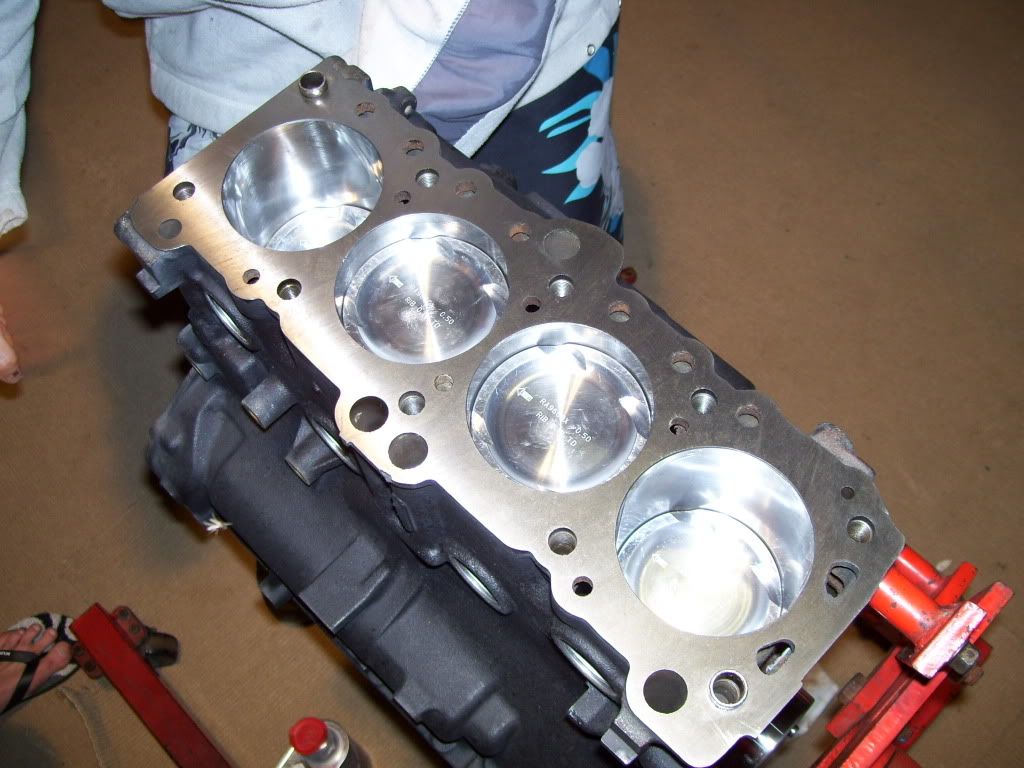
I re entered the pic's I took of the coolant routing , what you have to do to use the front coolant exit is to change the direction of coolant flow , this pic shows the original head gasket design which restrict coolant flow from the original thermostate location

in this pic you can see the two small holes at the front of the engine, they work just like holding your thumb over the end of a garden hose to speed up the coolant flow from this end of the cylinder head to the rear of the head

You just reverse the flow by opening up the original head gasket at the original thermostate end and placing two small restrictors in the front of the head

Last edited by Bill Hincher on Fri Mar 07, 2008 8:54 pm, edited 1 time in total.
-
Bill Hincher
- Donating Member
- Posts: 1625
- Joined: Thu Jun 22, 2006 8:57 pm
- Location: Toledo,Ohio
- Contact:

-
Bill Hincher
- Donating Member
- Posts: 1625
- Joined: Thu Jun 22, 2006 8:57 pm
- Location: Toledo,Ohio
- Contact:
check out the work we did here
http://projectzerog.com/forum/viewtopic ... 12&start=0
http://projectzerog.com/forum/viewtopic ... 12&start=0
-
Bill Hincher
- Donating Member
- Posts: 1625
- Joined: Thu Jun 22, 2006 8:57 pm
- Location: Toledo,Ohio
- Contact:
-
Bill Hincher
- Donating Member
- Posts: 1625
- Joined: Thu Jun 22, 2006 8:57 pm
- Location: Toledo,Ohio
- Contact:
Okay, lets try this again and see if you visualize what we are talking about, first the problem is that the coolant flow is designed to flow from the front ( cam gear end) to the rear ( orignal thermostate posistion), the way the engineers designed this in was by using two small holes at the front of the head and using Burnelli's laws to push coolant backwards . visualize holding your thumb over the end of a garden hose and making the water squirt harder in one direction
so two modifications are needed to use the front coolant exit, one is to open the second rear coolant passage in the head and and head gasket to reverse the flow using Burnelli's laws and push the coolant forward and the existing front coolant exits must be closed off, but not all the way, an opening should be left so no air locks can form in that area
so the two existing front coolant exits were tapped and allen screws were placed in the holes with very small holes drilled through the cnters so no air pockets can form and the second rear exit was added in the rear of the cylinder head and gasket to create forward flow . Now you are pointing the garden hose in the opposite direction and holding your thumb over the end of the hose making it move water faster
Now if you use a thermostate, you can use a remote thermostate that is fed coolant on the backside to control when it opens. this is a draw through system not a push system, so its mounted between the radiator and the engine at the bottom hose not pushed out the top of the engine. the advantage to this is that the thermostate is ' dynamic' in action not ' static', it constantly adjusts to different temperature inputs from both the engine and the radiator to cool the engine at a constant rate instead of just opening and closing at a given heat range
This is how it all comes together, the second real advantage to the draw through system is you hold the coolant in the radiator as long as possible before it enters the water pump to be distributed throughout the engine. that way you dont need a very large radiator in your design and still cool the engine

the surge tank is a very important in position and size to keep the water pump primed and avoiding any cavitation problems at the water pump impeller

and just as a touch of style, you can add a small hole in the up side of the thermostate so that the coolant mingles between the hot and cold coolant and prevent thermal shock to the engine block
so two modifications are needed to use the front coolant exit, one is to open the second rear coolant passage in the head and and head gasket to reverse the flow using Burnelli's laws and push the coolant forward and the existing front coolant exits must be closed off, but not all the way, an opening should be left so no air locks can form in that area
so the two existing front coolant exits were tapped and allen screws were placed in the holes with very small holes drilled through the cnters so no air pockets can form and the second rear exit was added in the rear of the cylinder head and gasket to create forward flow . Now you are pointing the garden hose in the opposite direction and holding your thumb over the end of the hose making it move water faster
Now if you use a thermostate, you can use a remote thermostate that is fed coolant on the backside to control when it opens. this is a draw through system not a push system, so its mounted between the radiator and the engine at the bottom hose not pushed out the top of the engine. the advantage to this is that the thermostate is ' dynamic' in action not ' static', it constantly adjusts to different temperature inputs from both the engine and the radiator to cool the engine at a constant rate instead of just opening and closing at a given heat range
This is how it all comes together, the second real advantage to the draw through system is you hold the coolant in the radiator as long as possible before it enters the water pump to be distributed throughout the engine. that way you dont need a very large radiator in your design and still cool the engine
the surge tank is a very important in position and size to keep the water pump primed and avoiding any cavitation problems at the water pump impeller
and just as a touch of style, you can add a small hole in the up side of the thermostate so that the coolant mingles between the hot and cold coolant and prevent thermal shock to the engine block
-
Bill Hincher
- Donating Member
- Posts: 1625
- Joined: Thu Jun 22, 2006 8:57 pm
- Location: Toledo,Ohio
- Contact:
-
Bill Hincher
- Donating Member
- Posts: 1625
- Joined: Thu Jun 22, 2006 8:57 pm
- Location: Toledo,Ohio
- Contact:
I think DJ and mainstream ( kane) have both done it and everything worked just like we wanted it to, I dont think anyone tried the draw through thermostate though, they all just run it without a thermostate
I have some more tests to do on the cooling system including a new designed water pump that will blow you away
please post a drawing of how your gonna set it up
Thanx
I have some more tests to do on the cooling system including a new designed water pump that will blow you away
please post a drawing of how your gonna set it up
Thanx
I'm definitely interested in this thread, but for my G54B head on an electric water pump set-up...
Should I be flowing water into the back of the head first?
I'm pulling water from the stock location on the front of the block.
I don't want to warp the head or the rear of the head not get any flow.... the other thing I need on the intake side in the rear is my water temp sensor.
I can also put that on the front or push water into both the front and the rear at the same time with a -an y fitting.
Thanks in advance!
Should I be flowing water into the back of the head first?
I'm pulling water from the stock location on the front of the block.
I don't want to warp the head or the rear of the head not get any flow.... the other thing I need on the intake side in the rear is my water temp sensor.
I can also put that on the front or push water into both the front and the rear at the same time with a -an y fitting.
Thanks in advance!
-
Bill Hincher
- Donating Member
- Posts: 1625
- Joined: Thu Jun 22, 2006 8:57 pm
- Location: Toledo,Ohio
- Contact:
depending on what you are doing with the car you really cant use an electric water pump, especially on the street at 12 volts you can not provide a pump with enough power to meet the demands for proper circulation
The pump should be pulling coolant from the radiator to the water pump and then distributed to the engine
Your probably right about coolant distribution, but there are some distribution problems. the internal combustion engine is a thermo disaster, as I pointed out before, 1/3 of the engines power is sent to the rear wheels while the other 2/3's of the engines power is converted to heat 1/3 to the exhaust and 1/3 to the coolant system. All three of those syatems must remain in balance, As you increase power by 50% you must balance out the higher heat ( wasted energy) by 100%, but you must not overcool the engine ,because you need the right amount of heat to get a good burn in the cylinder head
The pump should be pulling coolant from the radiator to the water pump and then distributed to the engine
Your probably right about coolant distribution, but there are some distribution problems. the internal combustion engine is a thermo disaster, as I pointed out before, 1/3 of the engines power is sent to the rear wheels while the other 2/3's of the engines power is converted to heat 1/3 to the exhaust and 1/3 to the coolant system. All three of those syatems must remain in balance, As you increase power by 50% you must balance out the higher heat ( wasted energy) by 100%, but you must not overcool the engine ,because you need the right amount of heat to get a good burn in the cylinder head
Yep, track only monster.
Well, the reason I'm scared to let the car heat up before the EWP kicks on at 160 degrees or so is simply because I don't want to warp the head... I mean I'm already dealing with the shittiest head Mitsu ever built... But I have to deal with it.
I'm honestly looking to just hardblock the motor and run coolant threw the head only... I know a few DSM's like this and they had the warping problem in the head when not running the pump all the time.
But, for right now I'm going to have a stock coolant filled block with maybe a hardblock on a stand for later.
Don't you just love the G54B?
Well, the reason I'm scared to let the car heat up before the EWP kicks on at 160 degrees or so is simply because I don't want to warp the head... I mean I'm already dealing with the shittiest head Mitsu ever built... But I have to deal with it.
I'm honestly looking to just hardblock the motor and run coolant threw the head only... I know a few DSM's like this and they had the warping problem in the head when not running the pump all the time.
But, for right now I'm going to have a stock coolant filled block with maybe a hardblock on a stand for later.
Don't you just love the G54B?
-
Bill Hincher
- Donating Member
- Posts: 1625
- Joined: Thu Jun 22, 2006 8:57 pm
- Location: Toledo,Ohio
- Contact:
-
DJpowerHaus
- Sir Post A Lot
- Posts: 1779
- Joined: Wed Apr 07, 2004 3:24 pm
- Location: Baltimore, MD
- Contact:
Not having the little holes at the front should be fine. I restricted mine down to pinholes to avoid theoretical steam accumulation while still coaxing coolant to the back of the block.
Since the factory didn't think it was necessary, I might just block them off completely next time.
Since the factory didn't think it was necessary, I might just block them off completely next time.
Getting the engine bolted in is about 10% of the way there.
The next 80% can go quickly with help and skill.
That last 10% takes about as long as the 90% that came before it.
-
DJpowerHaus
- Sir Post A Lot
- Posts: 1779
- Joined: Wed Apr 07, 2004 3:24 pm
- Location: Baltimore, MD
- Contact:
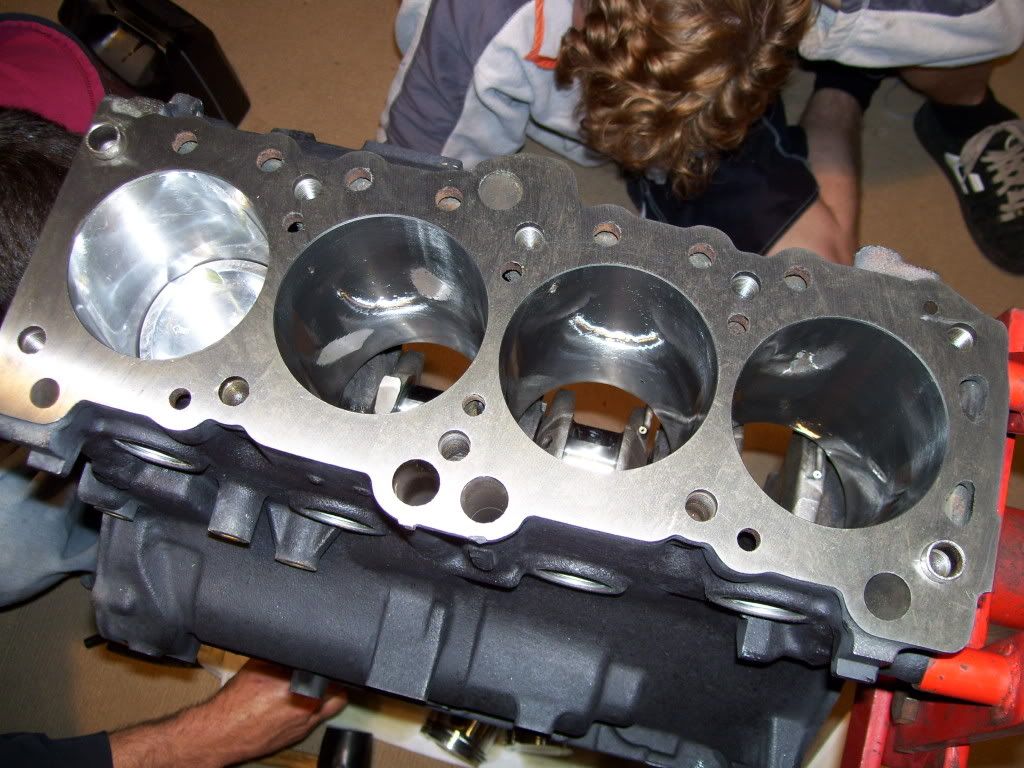
Can you get another one of those great pictures facing down as square as possible. The camera seems quite nice. Try to stay far back and zoom in. This should keep the distortion to a minimum. I'd like a copy.
Getting the engine bolted in is about 10% of the way there.
The next 80% can go quickly with help and skill.
That last 10% takes about as long as the 90% that came before it.