I been working out the basic plan for dry sump oil systems in the 4G63 and I need some help with specific's
I got the pump worked out and the resivour.
The oil pan will be built with scrapers and screens but the oil pick up is where I need some help, drifting seems to use left and right turns so I dont have a preveliant side.
Horse power gains can be added with a bigger sump so its to my advantage to add a front or rear sump
what would be best? a two peice oil pan that could bolt on a front or rear sump? or a one peice pan that ' fits all' and is shallow ?
Dry sump oil system for the 4G63
Moderators: DJpowerHaus, mattmartindrift
-
Bill Hincher
- Donating Member
- Posts: 1625
- Joined: Thu Jun 22, 2006 8:57 pm
- Location: Toledo,Ohio
- Contact:
http://www.daileyengineering.com/main.htm
I was thinking about dry sumps for another motor I was building. I came across these guys and they seem to have some trick stuff. They show some pretty good pics of their pans.
Would you care to go into a little more detail on your dry sump plans?
I was thinking about dry sumps for another motor I was building. I came across these guys and they seem to have some trick stuff. They show some pretty good pics of their pans.
Would you care to go into a little more detail on your dry sump plans?
-
Bill Hincher
- Donating Member
- Posts: 1625
- Joined: Thu Jun 22, 2006 8:57 pm
- Location: Toledo,Ohio
- Contact:
excellent point,
I think dividing off 1-2 & 3-4 cylinders makes excellent sense, the horse power gains in the oil pan are controled by how much air space is required to allow the volume of air from the bottom of the piston to flow out from its downward motion, that would be offset by the riasing piston next to the lowering piston and give good balance
in order to keep costs down, I would preffer using two Scavange side pumps, but where is the best placing of the oil pick ups for Scavanging?
I think dividing off 1-2 & 3-4 cylinders makes excellent sense, the horse power gains in the oil pan are controled by how much air space is required to allow the volume of air from the bottom of the piston to flow out from its downward motion, that would be offset by the riasing piston next to the lowering piston and give good balance
in order to keep costs down, I would preffer using two Scavange side pumps, but where is the best placing of the oil pick ups for Scavanging?
-
DJpowerHaus
- Sir Post A Lot
- Posts: 1779
- Joined: Wed Apr 07, 2004 3:24 pm
- Location: Baltimore, MD
- Contact:
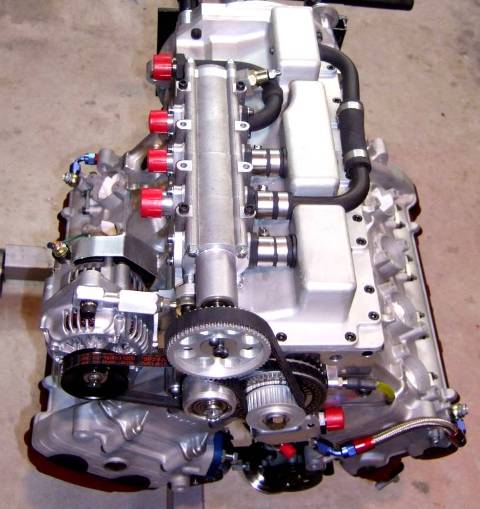
-
Robert Venable
- Donating Member
- Posts: 229
- Joined: Fri Sep 22, 2006 8:37 pm
- Location: BATON ROUGE, LA
-
Bill Hincher
- Donating Member
- Posts: 1625
- Joined: Thu Jun 22, 2006 8:57 pm
- Location: Toledo,Ohio
- Contact:
yeah Bob, I been looking at crank scrapers and they are working on the left side of the crank ( drivers side) where the crank is in the upward rotation
The screens they use are designed so the oil cant spash up after it has dropped down in the pan so you need some depth in the sump. When building the oil pan, I figure on making the left ( rear ) side of the oil pan wider and flat instead of round so it collects oil better. I will probably make the oil pan in a 2 piece, the upper section cast aluminum and the lower sump sheet aluminum
I figured placing the pick ups on the left side of the engine, in two compartments ( as mainstream suggested) and placing the oil pump in the A/C compressor spot.
I hope to make it so it will fit FWD drive cars too, so that position works the best for me
I been busting my ass on this EVO engine set up and the T 56 4G63 set up , but I found a lot of dry sump stuff on E bay and I have most of the parts I need so stay tuned
drawings, schematics, ideas are all welcome at this point
The screens they use are designed so the oil cant spash up after it has dropped down in the pan so you need some depth in the sump. When building the oil pan, I figure on making the left ( rear ) side of the oil pan wider and flat instead of round so it collects oil better. I will probably make the oil pan in a 2 piece, the upper section cast aluminum and the lower sump sheet aluminum
I figured placing the pick ups on the left side of the engine, in two compartments ( as mainstream suggested) and placing the oil pump in the A/C compressor spot.
I hope to make it so it will fit FWD drive cars too, so that position works the best for me
I been busting my ass on this EVO engine set up and the T 56 4G63 set up , but I found a lot of dry sump stuff on E bay and I have most of the parts I need so stay tuned
drawings, schematics, ideas are all welcome at this point
-
DJpowerHaus
- Sir Post A Lot
- Posts: 1779
- Joined: Wed Apr 07, 2004 3:24 pm
- Location: Baltimore, MD
- Contact:
-
Bill Hincher
- Donating Member
- Posts: 1625
- Joined: Thu Jun 22, 2006 8:57 pm
- Location: Toledo,Ohio
- Contact:
I was talking to some engineers at Melling oil pumps and I was suprised to find out the biggest problem with dry sumping is wrist pins
wrist pins rely soley on the oil mist to lubricate, so if you set up your dry sump to pull so hard that it creates a vacuum, the wrist pins will dry out and seize, not to mention you have to change all the seals in the engine so they dont turn inside out, so proper venting is a must to prevent this problem. I imagine having squirters in the block should be installed also
But anyway, 2 to 1 seems to be the right ratio between the salvage pumps and the pressure side pump, you want twice as much pulling oil out then you have pushing in
wrist pins rely soley on the oil mist to lubricate, so if you set up your dry sump to pull so hard that it creates a vacuum, the wrist pins will dry out and seize, not to mention you have to change all the seals in the engine so they dont turn inside out, so proper venting is a must to prevent this problem. I imagine having squirters in the block should be installed also
But anyway, 2 to 1 seems to be the right ratio between the salvage pumps and the pressure side pump, you want twice as much pulling oil out then you have pushing in
-
DJpowerHaus
- Sir Post A Lot
- Posts: 1779
- Joined: Wed Apr 07, 2004 3:24 pm
- Location: Baltimore, MD
- Contact:
-
Bill Hincher
- Donating Member
- Posts: 1625
- Joined: Thu Jun 22, 2006 8:57 pm
- Location: Toledo,Ohio
- Contact:
I been pressing hard to complete orders for the R 154 bellhousings
I will be posting the work right after I complete the bellhousing for the T 56
I got a guy on vacation this week so I will have to work at my other shop this week
I am going to build a cast oil pan , I think it will be a much nicer unit
I will be posting the work right after I complete the bellhousing for the T 56
I got a guy on vacation this week so I will have to work at my other shop this week
I am going to build a cast oil pan , I think it will be a much nicer unit
-
DJpowerHaus
- Sir Post A Lot
- Posts: 1779
- Joined: Wed Apr 07, 2004 3:24 pm
- Location: Baltimore, MD
- Contact:
Just throwing this out there. Can you include a boss so people can add turbo oil drain fittings?
Is there any need to have any scavenging in the head? I'm guessing you're using a 3 stage pump so our options may be limited.
Is there any need to have any scavenging in the head? I'm guessing you're using a 3 stage pump so our options may be limited.

Getting the engine bolted in is about 10% of the way there.
The next 80% can go quickly with help and skill.
That last 10% takes about as long as the 90% that came before it.
-
Bill Hincher
- Donating Member
- Posts: 1625
- Joined: Thu Jun 22, 2006 8:57 pm
- Location: Toledo,Ohio
- Contact:
well, I figure the FWD guys will wanna try it out too, thus the left side pick up and left side pump mount, that will all fit nicely into a FWD project.
My primary concern is to hold the cost down, its free horse power really, like headders, once its in place and properly tuned, it doesnt cost a cent and it can add 10% to overall engine output and the REALLY nice thing is, no violation of EPA laws. It is important to understand, you are violating FEDERAL law when you sell goods that tamper with engine emmisions.
anyway having said that, I will be sure to add enough inlets and outlets so the oil pan can be used in any position.
The system will be done in a way so you can use 3 stage or use a 2 stage to scavage the pan and the existing oil pump for pressure.
if you scavaged oil out of the pan at a rate of 2 to 1 and fed the oil into a remote resivour, whats the advantage to using the third stage of the pump to supply oil to the engine? it adds $3 to 400 bucks to the purchase price of the pump
the original advantage was to have an external adjustment to regulate oil pressure, well, you already got that with the 4G63
second advantage was more volume, well, you can only push one quart of oil through the same size oil passageways at the same rate of speed, so I dont see the advantage there, your just trying to push 5 pounds of oil through a 3 pound hole. If you are going to increase the volume of oil by 20% then you must port the engine block oil galleys 20% larger to handle that extra amount of oil, ( just like an intake port needs more air). I can understand this work being done if you are buiding a world beater but its a lot of work.
the other reason to stay with the original oil pump is because your timing belt has to route over the geared pulley anyway, might as well use it, no need to change the oil filter arrangement or the oil bypass system or the oil cooler, its all there from the manufacturer
and another advantage to a two stage would be the power steering pump, it could be mounted behind the external oil pump to save room
I dont see the advantage to the third oil outlet in the valve cover, that is only used when you have consistant long high speed turns that the oil would be gathered into the head in a consistant area, and Mitsubishi already restricts oil to the upper end , so venting is more important in the valve cover area, venting helps the engine breathe so it doesnt develop ' piston ring flutter'. crankcase pressure puses against the bottom of the piston on its downstroke.I would like to see 10 CFM of air flow in the valve cover breathers. I have to stress the fact, I dont want to create a vaccum in the crankcase area by have too high of a scavage rate
but, I am still researching it, so anything can happen >;o)
My primary concern is to hold the cost down, its free horse power really, like headders, once its in place and properly tuned, it doesnt cost a cent and it can add 10% to overall engine output and the REALLY nice thing is, no violation of EPA laws. It is important to understand, you are violating FEDERAL law when you sell goods that tamper with engine emmisions.
anyway having said that, I will be sure to add enough inlets and outlets so the oil pan can be used in any position.
The system will be done in a way so you can use 3 stage or use a 2 stage to scavage the pan and the existing oil pump for pressure.
if you scavaged oil out of the pan at a rate of 2 to 1 and fed the oil into a remote resivour, whats the advantage to using the third stage of the pump to supply oil to the engine? it adds $3 to 400 bucks to the purchase price of the pump
the original advantage was to have an external adjustment to regulate oil pressure, well, you already got that with the 4G63
second advantage was more volume, well, you can only push one quart of oil through the same size oil passageways at the same rate of speed, so I dont see the advantage there, your just trying to push 5 pounds of oil through a 3 pound hole. If you are going to increase the volume of oil by 20% then you must port the engine block oil galleys 20% larger to handle that extra amount of oil, ( just like an intake port needs more air). I can understand this work being done if you are buiding a world beater but its a lot of work.
the other reason to stay with the original oil pump is because your timing belt has to route over the geared pulley anyway, might as well use it, no need to change the oil filter arrangement or the oil bypass system or the oil cooler, its all there from the manufacturer
and another advantage to a two stage would be the power steering pump, it could be mounted behind the external oil pump to save room
I dont see the advantage to the third oil outlet in the valve cover, that is only used when you have consistant long high speed turns that the oil would be gathered into the head in a consistant area, and Mitsubishi already restricts oil to the upper end , so venting is more important in the valve cover area, venting helps the engine breathe so it doesnt develop ' piston ring flutter'. crankcase pressure puses against the bottom of the piston on its downstroke.I would like to see 10 CFM of air flow in the valve cover breathers. I have to stress the fact, I dont want to create a vaccum in the crankcase area by have too high of a scavage rate
but, I am still researching it, so anything can happen >;o)
Bill, I am confused, are you saying you are building a drysump unit which will utilize the factory pump? If not which type/brand of external pump are you thinking of. Either which way, I am interested in one (for an AWD motor), and I was thinking of making one up myself. When do you think they will be ready.
-
Bill Hincher
- Donating Member
- Posts: 1625
- Joined: Thu Jun 22, 2006 8:57 pm
- Location: Toledo,Ohio
- Contact:
-
DJpowerHaus
- Sir Post A Lot
- Posts: 1779
- Joined: Wed Apr 07, 2004 3:24 pm
- Location: Baltimore, MD
- Contact:
For the DSM guys, have you checked the clearance between the crank pulley and the frame rail? If I remember right there is not much room there at all. Might be hard to have the drive sprocket there.
Getting the engine bolted in is about 10% of the way there.
The next 80% can go quickly with help and skill.
That last 10% takes about as long as the 90% that came before it.
-
Robert Venable
- Donating Member
- Posts: 229
- Joined: Fri Sep 22, 2006 8:37 pm
- Location: BATON ROUGE, LA
-
Bill Hincher
- Donating Member
- Posts: 1625
- Joined: Thu Jun 22, 2006 8:57 pm
- Location: Toledo,Ohio
- Contact:
if I were building a specific engne for a specific purpose and I could dictate exact vacuum values I would do it, but vacuum in the crankcase is only used when the sole purpose of the engine is high RPM,s such as nascar racing or drag racing
because you are driving on the street or drifting, you are duplicating conditions from sprint car racers, which dont have enough wide open throttle time to develop usable crankcase vacuum
If you got excessive crankcase vapor in your combustion chamber, I would suggest you have a piston ring or crankcase ventilation problem
because you are driving on the street or drifting, you are duplicating conditions from sprint car racers, which dont have enough wide open throttle time to develop usable crankcase vacuum
If you got excessive crankcase vapor in your combustion chamber, I would suggest you have a piston ring or crankcase ventilation problem
-
Bill Hincher
- Donating Member
- Posts: 1625
- Joined: Thu Jun 22, 2006 8:57 pm
- Location: Toledo,Ohio
- Contact:
just so you guys dont think I am resting  I thought I would show you the test stand I am building for the dry sump systems

I needed to build a manifold that will work with mulitple pumps

then I had to build an imitation resivour
 I put in a preheater so I could get the oil hot
 and I put a flow meter in so i can measure the volume of oil

I bought a weaver drysump system to see how they were built and I was dickin around building one from scratch

winter is here,38 degrees, 2 inches of wet heavy rain / sleet / snow, so I guess its time to work on my cars and projects
I thought I would show you the test stand I am building for the dry sump systemsI needed to build a manifold that will work with mulitple pumps
then I had to build an imitation resivour
I put in a preheater so I could get the oil hot and I put a flow meter in so i can measure the volume of oilI bought a weaver drysump system to see how they were built and I was dickin around building one from scratch
winter is here,38 degrees, 2 inches of wet heavy rain / sleet / snow, so I guess its time to work on my cars and projects
Last edited by Bill Hincher on Wed Jul 27, 2011 6:17 pm, edited 1 time in total.
-
DJpowerHaus
- Sir Post A Lot
- Posts: 1779
- Joined: Wed Apr 07, 2004 3:24 pm
- Location: Baltimore, MD
- Contact:
Awesome work. How are you planning on driving the pump? I was thinking about the universality and a crank mounted sprocket. It would hit the frame rail when used for GalantVR4/Eclipse/Evo (transverse) setups.
For us RWD guys though, a nice crank damper would be nice.
11,000rpm here I come (for 2009)!
For us RWD guys though, a nice crank damper would be nice.
11,000rpm here I come (for 2009)!
Getting the engine bolted in is about 10% of the way there.
The next 80% can go quickly with help and skill.
That last 10% takes about as long as the 90% that came before it.
-
DJpowerHaus
- Sir Post A Lot
- Posts: 1779
- Joined: Wed Apr 07, 2004 3:24 pm
- Location: Baltimore, MD
- Contact:
I'll likely be tilting the engine like that RX7 guy did which would put the exhaust (passenger side) down which should be the same side which the windage should collect in.Bill Hincher wrote:if I were building a specific engne for a specific purpose and I could dictate exact vacuum values I would do it, but vacuum in the crankcase is only used when the sole purpose of the engine is high RPM,s such as nascar racing or drag racing
because you are driving on the street or drifting, you are duplicating conditions from sprint car racers, which dont have enough wide open throttle time to develop usable crankcase vacuum
If you got excessive crankcase vapor in your combustion chamber, I would suggest you have a piston ring or crankcase ventilation problem
Getting the engine bolted in is about 10% of the way there.
The next 80% can go quickly with help and skill.
That last 10% takes about as long as the 90% that came before it.
-
Bill Hincher
- Donating Member
- Posts: 1625
- Joined: Thu Jun 22, 2006 8:57 pm
- Location: Toledo,Ohio
- Contact:
we got to get together on the oil pan, because this set up is for multiple swaps, some guys are going to have room for front sumps and some guys may want rear sumps and some cars wont want sumps at all.
The volume of the oil pan wants to be as large as we can get it, so I am thing about expanding it out to each side instead of lowering the sump
all that aside, the first thing I am going to do is test the original pump for VOLUME and then work backwards from that number
if we can INCREASE the volume and LOWER the pressure it would be great!
The volume of the oil pan wants to be as large as we can get it, so I am thing about expanding it out to each side instead of lowering the sump
all that aside, the first thing I am going to do is test the original pump for VOLUME and then work backwards from that number
if we can INCREASE the volume and LOWER the pressure it would be great!
-
Robert Venable
- Donating Member
- Posts: 229
- Joined: Fri Sep 22, 2006 8:37 pm
- Location: BATON ROUGE, LA
What about building a 2 piece pan? Build it so that the upper part is universial, and that the bolt pattern for bolting the lower oil pan would allow for you to use a single sump as either a forward or rearward sump (just turn it around). For those that wanted no/low sump-- you could just bolt up a flat plate.
It would be really nice if you could cut an "o-ring groove" into it so it could be self sealing without sealant.
It would be really nice if you could cut an "o-ring groove" into it so it could be self sealing without sealant.
1990 MIGHTY MAX, REG CAB,
-
DJpowerHaus
- Sir Post A Lot
- Posts: 1779
- Joined: Wed Apr 07, 2004 3:24 pm
- Location: Baltimore, MD
- Contact:
-
Bill Hincher
- Donating Member
- Posts: 1625
- Joined: Thu Jun 22, 2006 8:57 pm
- Location: Toledo,Ohio
- Contact:
Bob's right on with his input, I beleive there is an oportunity to use a casted oil pan base that could include some cooling fins and then a 'cap' for the bottom half that would be interchangeable
That would also allow assembly advangtages because you could correct any scrapers or screens visually before you assemble that system . What I am really intrested in is, the sides of the oil pan, I am going to have to choose a side that can be expanded to accept the oil slung off the crankshaft. Is there enough room in the frame rails to accept an expanded side , I beleive will be on the drivers side of the pan? The reason I want to use the drivers side is because it may be used in the FWD cars .
I apoligize for being so late with all this stuff, I an determined to have it ready for DJ before next season starts, so if you guys have input , please jump in and help
That would also allow assembly advangtages because you could correct any scrapers or screens visually before you assemble that system . What I am really intrested in is, the sides of the oil pan, I am going to have to choose a side that can be expanded to accept the oil slung off the crankshaft. Is there enough room in the frame rails to accept an expanded side , I beleive will be on the drivers side of the pan? The reason I want to use the drivers side is because it may be used in the FWD cars .
I apoligize for being so late with all this stuff, I an determined to have it ready for DJ before next season starts, so if you guys have input , please jump in and help


-
Bill Hincher
- Donating Member
- Posts: 1625
- Joined: Thu Jun 22, 2006 8:57 pm
- Location: Toledo,Ohio
- Contact:
-
Bill Hincher
- Donating Member
- Posts: 1625
- Joined: Thu Jun 22, 2006 8:57 pm
- Location: Toledo,Ohio
- Contact:
Bill Pauter offer rifle drilling of the rods to lubricate the gudgeon pins.Bill Hincher wrote:I was talking to some engineers at Melling oil pumps and I was suprised to find out the biggest problem with dry sumping is wrist pins
wrist pins rely soley on the oil mist to lubricate, so if you set up your dry sump to pull so hard that it creates a vacuum, the wrist pins will dry out and seize, not to mention you have to change all the seals in the engine so they dont turn inside out, so proper venting is a must to prevent this problem. I imagine having squirters in the block should be installed also
But anyway, 2 to 1 seems to be the right ratio between the salvage pumps and the pressure side pump, you want twice as much pulling oil out then you have pushing in
-
jeffball610
- Too Much Time on His Hands
- Posts: 619
- Joined: Wed Feb 22, 2006 5:29 am
- Location: Las Vegas, NV
This is why you should start with a turbo block. It has piston oil squirters built in. Helps cool the pistons, and lubricates the wrist pins.Bill Hincher wrote:I was talking to some engineers at Melling oil pumps and I was suprised to find out the biggest problem with dry sumping is wrist pins
wrist pins rely soley on the oil mist to lubricate, so if you set up your dry sump to pull so hard that it creates a vacuum, the wrist pins will dry out and seize, not to mention you have to change all the seals in the engine so they dont turn inside out, so proper venting is a must to prevent this problem. I imagine having squirters in the block should be installed also
But anyway, 2 to 1 seems to be the right ratio between the salvage pumps and the pressure side pump, you want twice as much pulling oil out then you have pushing in
Do it in a Datsun!
1972 Datsun 510
7-bolt 4G63T, EVO 9 pistons and rods, Garrett GT3076R, "flipped" stock intake, Toyota R154, Z31 R200 w/ CVs
1972 Datsun 510
7-bolt 4G63T, EVO 9 pistons and rods, Garrett GT3076R, "flipped" stock intake, Toyota R154, Z31 R200 w/ CVs
-
DJpowerHaus
- Sir Post A Lot
- Posts: 1779
- Joined: Wed Apr 07, 2004 3:24 pm
- Location: Baltimore, MD
- Contact:
For squirters, wouldn't it be easier to just run oil from a source other than the main galley to a manifold in the bottom end that feeds oil via 4 small metal lines?
If passing the lines through the oil pan is too tough, keep it all internal and run it from a source on the head down the oil returns into the bottom end.
If passing the lines through the oil pan is too tough, keep it all internal and run it from a source on the head down the oil returns into the bottom end.
Getting the engine bolted in is about 10% of the way there.
The next 80% can go quickly with help and skill.
That last 10% takes about as long as the 90% that came before it.
-
Bill Hincher
- Donating Member
- Posts: 1625
- Joined: Thu Jun 22, 2006 8:57 pm
- Location: Toledo,Ohio
- Contact:
-
PoorMans180SX
- Knowlege Seeker
- Posts: 9
- Joined: Mon Jan 02, 2012 3:42 pm