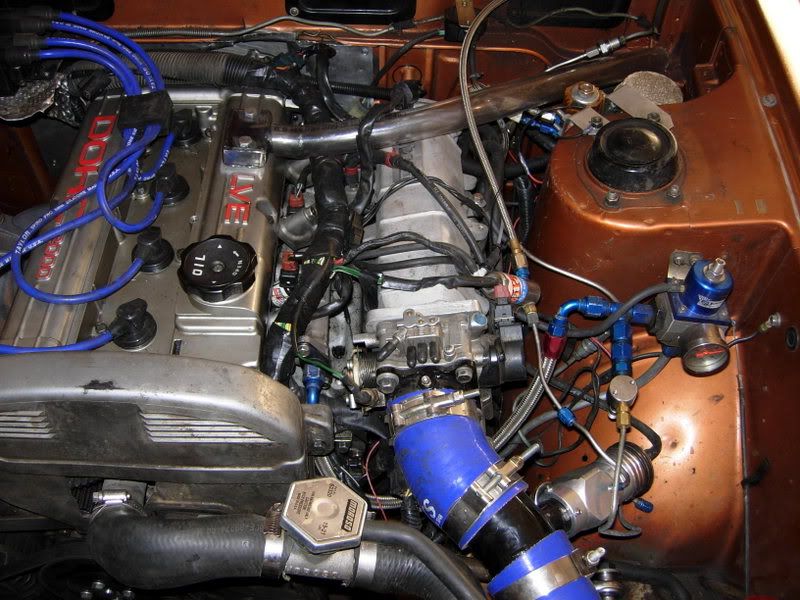
I have been asked to post my results in using a front water (out the front freeze plug hole). I have had the set up for three years now and have no complaints. I just welded a tube directly to the head (this was before anyone made adapters) and built a block off plate for the back of the head. I modified a 2.0 truck pump and that was about it. I used a radiator from a turbo volvo from the early ninetys.
Cooling:
The car runs cool during our warm summers (80's to high 90's) with a decent fan cruising or racing. My only trouble is that during our cool winters the temp will get as low as 120 degrees cruising because I do not have a thermostat. I just made a block off plate to cover half of the Radiator and it ran 160-180 in 20 degree weather. Other than that I would say that for packaging, simplicity and reliability (less fittings and hoses going everywhere) it is definatly the way to go if you are a 4g63 RWD car. I relocated my temp sensors (ECM and Gauge) to my block off plate at the back of the head. I figured that Mitsubishi put them there, and so will I.
At least with the temp sensors at the back, if there is any problems you will see them at the apparent potential problem area!
What block are you using? Did you have to modify the front water gallery that goes through the front of the gasket/
the top inlet of the radiator should be the hottest place in the cooling system, it is the end destination of the coolant after it is heated, if the radiator is working right the difference between the top inlet and the bottom outlet of the radiator should be about ten percent
Bill Hincher wrote:the top inlet of the radiator should be the hottest place in the cooling system, it is the end destination of the coolant after it is heated, if the radiator is working right the difference between the top inlet and the bottom outlet of the radiator should be about ten percent
"Should be" is the defining statement. Considering that we are reverse engineering the cooling system, I think it is a VERY good thing that who ever does this modification verify that there are no hot spots in the rear of the head.
Bill Hincher wrote:the top inlet of the radiator should be the hottest place in the cooling system, it is the end destination of the coolant after it is heated, if the radiator is working right the difference between the top inlet and the bottom outlet of the radiator should be about ten percent
"Should be" is the defining statement. Considering that we are reverse engineering the cooling system, I think it is a VERY good thing that who ever does this modification verify that there are no hot spots in the rear of the head.
yea thats the one thing stopping me at the moment
i have neither the money nor the knowledge to risk/trial this sort of thing and risk a blown headgasket, warped head etc
but o so keen and hoping that it does work well
as trying to sort out my water pipes from the rear is currently a rather large headache
If you want your ECU to work correctly you must have predictable tempurate inputs to the ECU
a thermostate is a must if you expect the exact same performance from your car everytime you run it.
If you are not going to run a thermostate, then you must trick the ECU by placing a resistor in place of the thermosensor, Mitsubishi likes to run 2500 ohm resistance cold ( 68 degrees) and 275 ohms hot ( 176 degrees)
so if you want your ECU to read a warm engine, place a 275 ohm resistor from Radio Shack across you input sensor wiring outlet , if you want to let the ECU read cold, place a 2500 ohm resister across the wiring termainal.
where you loose performance is in the cylinder head temp, you need at least 200 degrees cylinder head temp to get a complete burn. If you dont have a predictable cylinder head temp to work with, you can not properly tune the engine for performance
I don't know what potential problem areas you guys are refering to, but a motor is a motor. If coolant can flow around the chamber I doubt it makes enough difference what end of the head it comes out at the sub 600 hp level, and the ECM has never given me any problems other than a high idle when its cold out. At the track it has always been consistant no matter what temp the motor is at.
My motor is a stock JDM motor. I used a cheapy fel pro with an ARP stud kit when I first built the car, other wise it was stock. I ran it this way for 2 years trouble free, with alot of street driving and racing as well. It did'nt blow a head gasket till I put a 125 shot of nitrous on top of 20 psi (16G) through it without any timing control (ran 11.20 @ 4500 ft elevation). I put in a cometic, had the head ported/surfaced, put FP2's in, bought DSMlink, and have had no problems with the head gasket since. I made 4 passes in the high 11's in April within a tenth of each other with about 15 psi, a 60-1, and a very conservative tune. I would like to report what it ran with the boost turned up but the Pick and Pull U joint gave up the ghost and ended my night.
There is no reason anyone should be afraid to run water out of the front of the head. The block that you have the head bolted to was designed to water out the front originally anyways, and that iteration has been around a long long time. In my humble yet educated opinion, there is no risk (provided you have a decent cooling capacity and fan) in doing this.
What potential problem areas I (and many others from what I gather) are worried about is hot spots that have inadequate or no water flow.
You are right that the block was designed to run water in the method you are reffering to, but don't forget that the only real diff. between the two blocks is the added 6mm of height (cooling wise).
The fact is, the head was NOT designed to run water threw it in this manor, and this is where the majority of your heat is. This makes me want to MAKE SURE, that I don't run into those potential hot spots.
Also, I want to run a thermostate when I build my engine, so I want to make sure that there is no stagnant water that doesn't flow at the location of the thermostate delaying it's operation.
Hell, I'm going to try this. My car is far enough away from getting built that if someone does have an issue, I can always back out. Jay Racing makes a kit to run the thermostat off that same front passage. So you have a thermostat and a place to put coolant. It will also house the proper temp sensors where the factory meant them to be. In the thermostat housing. Now we just need to find out if the head will cool properly. Let's not forget, that if you plumb the fuel system in a stock fashion, the #4 cylinder will be the coolest since the most fuel will reach it. (in theory) That's why you put your EGT probe in the #1 cylinder runner, it runs the leanest and should produce the most heat. We'll see what happens. Worse case scenario, you blow the head apart and have to get another motor. If you're running stock DSM stuff, it probably won't cost more that $500 to replace. (not that $500 is nothing to some of us)
Someone could always perform an experiment with 4 thermocouples bonded between the exhaust valves and pump hot water through the block and head and measure the temperature response with time. If the temperature profiles are different then you restrict the flow between the head and block at the front if the back cylinder temperature is low. Then repeat the experiment to see how the changes have effected the temperature profiles etc. The engine does not have to be fully assembled, just the water passages sealed. The only specialized equipment required is a device to record the thermocouple signals, but you could do this by hand with 1 digital multimeter and paper as the time constant will be quite long (minutes).
Robert Venable wrote:What potential problem areas I (and many others from what I gather) are worried about is hot spots that have inadequate or no water flow.
You are right that the block was designed to run water in the method you are reffering to, but don't forget that the only real diff. between the two blocks is the added 6mm of height (cooling wise).
The fact is, the head was NOT designed to run water threw it in this manor, and this is where the majority of your heat is. This makes me want to MAKE SURE, that I don't run into those potential hot spots.
Also, I want to run a thermostate when I build my engine, so I want to make sure that there is no stagnant water that doesn't flow at the location of the thermostate delaying it's operation.
Well, all I can tell you guys is I have tried it, street driving, racing, driving to and from racing and everything in between. You guys can conject and hypothisize all you want, but I went ahead and built it and it worked. I doubt many of you will beat on the motor as much as I have, and these cylinder to cylinder heat distribution problems you are talking about have yet to plague me, sorry. I even ran a 125 shot through a single nozzle and the plugs always read consistant (front to back). It has always comped out 140 accross the board and the last time I checked the pistons the burn patterns were consistant, and looked like every other 4g that has had nitrous through it (I have seen quite a few). Luckily when I built the car there were no websites around to warn me against just building stuff and trying it, I would have still not made a pass . I will leave the subject now to all of the experts on cylinder head combustion chamber cooling design and just stick to racing my junk.

 . I will leave the subject now to all of the experts on cylinder head combustion chamber cooling design and just stick to racing my junk.